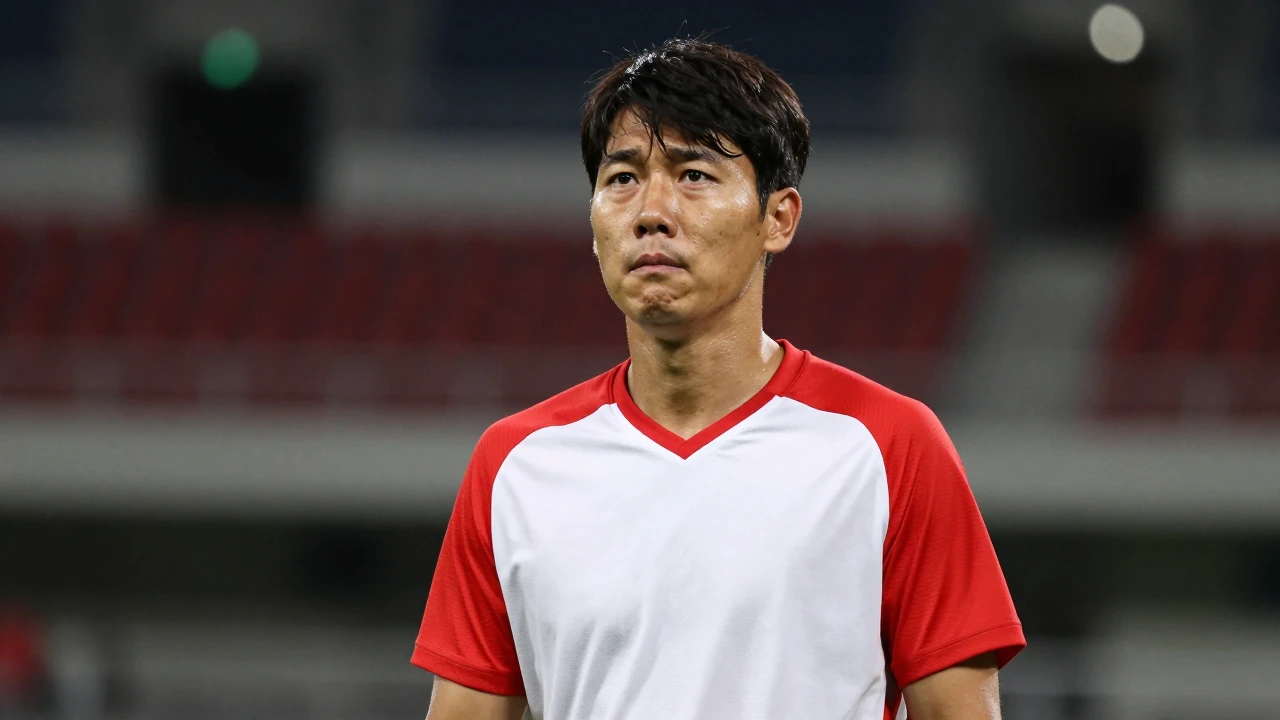
The 2026 K-Football Innovation Committee held a listening session on the 19th at Korea Football Park in Cheonan. Key figures such as Minister of Culture, Sports and Tourism Choi Hwi-yeong, Innovation Committee Chairman Park Ji-sung, and commentator Lee Young-pyo attended.
Lack of Playing Fields and Climate Issues
During the session, concerns were raised that competitions concentrated in the hot summer and cold winter periods lead to decreased performance and injury risks for players. Gwangyeok Elementary School fifth-grade player Gyeol Yun-woo said, "The artificial turf gets so hot in summer that it can cause burns, so sprinklers are absolutely necessary." Incheon High School coach Cho Seong-ho pointed out that "our kids have been injured playing in winter, and health problems are severe in summer."
Shortage of Dedicated Fields
Although over half of Korean youth football teams are registered in Seoul, Incheon, and Gyeonggi-do, there is a lack of dedicated fields and infrastructure to support them. Youth coach Lee Se-hyun of Cheonan FMC FC said, "Youth development is most important in grassroots football, but Seoul lacks fields, so we must secure fields first for talent scouting." Coach Ryu Seong-hyun of Hanamum FC complained that school fields are restricted by the "non-profit use" clause, making them difficult to use.
Playing Time and Education Structure
A structural problem is that actual match time is limited to about two years for youth players. Third-year student Kim Jae-min of Yongmun High School said, "Because footballers cannot attend university on a regular schedule, they only go on a rolling basis, leading to overload until July and no training space thereafter." Coach Kim Min-deok Jin-geon-ch’o noted, "After seeing European tournaments, we realized how few matches our players get; they hold only up to three tournaments a year, whereas Europe holds dozens annually."
Decline in Women’s Football Registration
Women’s football, which already has a smaller base than men’s, is also experiencing declining registration. Elementary school clubs often have only one or two female players, and they need a clear academic pathway. Female registration numbers fell from 1,764 in 2014 to 1,570 in 2023.
Committee’s Response
Chairman Park Ji-sung said, "The lack of fields for players to freely run is the most shocking issue," adding that "the problem is not only the Korean Football Association but the entire football industry’s responsibility." He added, "The important thing is direction. Since the committee’s launch last month, we have met weekly, and on the 4th we recommended governance to the association. We will monitor implementation and provide administrative support."
Minister Choi Hwi-yeong remarked, "The committee was launched to address World Cup performance, and restoring trust in Korean football is priority, but the request for a playing environment is heavy on my heart." He concluded, "As the minister of the relevant department, I promise to solve these problems and will not neglect young players."